

Your lesson workspace
Watch, read and use the supporting resources before continuing.
Visa Application Overview
Visa Application Overview
-
Primary study visa type: Long-Stay Visa (Type D) for Study
A long-stay student visa that allows entry to Bulgaria for up to 180 days. During this period, students must apply for a residence permit to remain for the full course duration.
Visa Requirements
Visa Requirements
Students who require a visa to study must be informed that visa rules vary by destination country and nationality, and it is the student’s responsibility to meet all immigration requirements. Application Managers should guide students to consult our guide as well as official government immigration websites for the most accurate and up-to-date information.
In general, visa applications typically require the following:
-
A valid passport with sufficient remaining validity and blank pages.
-
An official acceptance letter from the Ministry of Education (Visa Letter).
-
Proof of payment or confirmation of course fees, where required.
-
Evidence of sufficient financial means to cover tuition, accommodation, and living expenses.
-
Proof of accommodation arrangements for the duration of the stay, if applicable.
-
Travel itinerary or intended arrival details.
-
Health insurance coverage where mandated by the destination country.
-
Completed visa application forms and payment of applicable fees.
-
Biometric data submission and/or an in-person interview, depending on the country.
Students must be advised that visa processing times vary and may change without notice. They should regularly check official embassy or consulate websites for processing updates, required documentation, and appointment availability.
Application Managers should not provide immigration advice beyond procedural guidance. When students require clarification on eligibility, documentation, or legal matters, they must be directed to the relevant embassy, consulate, or official immigration authority.
Who needs a visa?
Who needs a visa?
The table below provides guidance on who needs a visa and who does not.
-
No Visa Needed
-
Visa Free Regime
-
Visa Needed

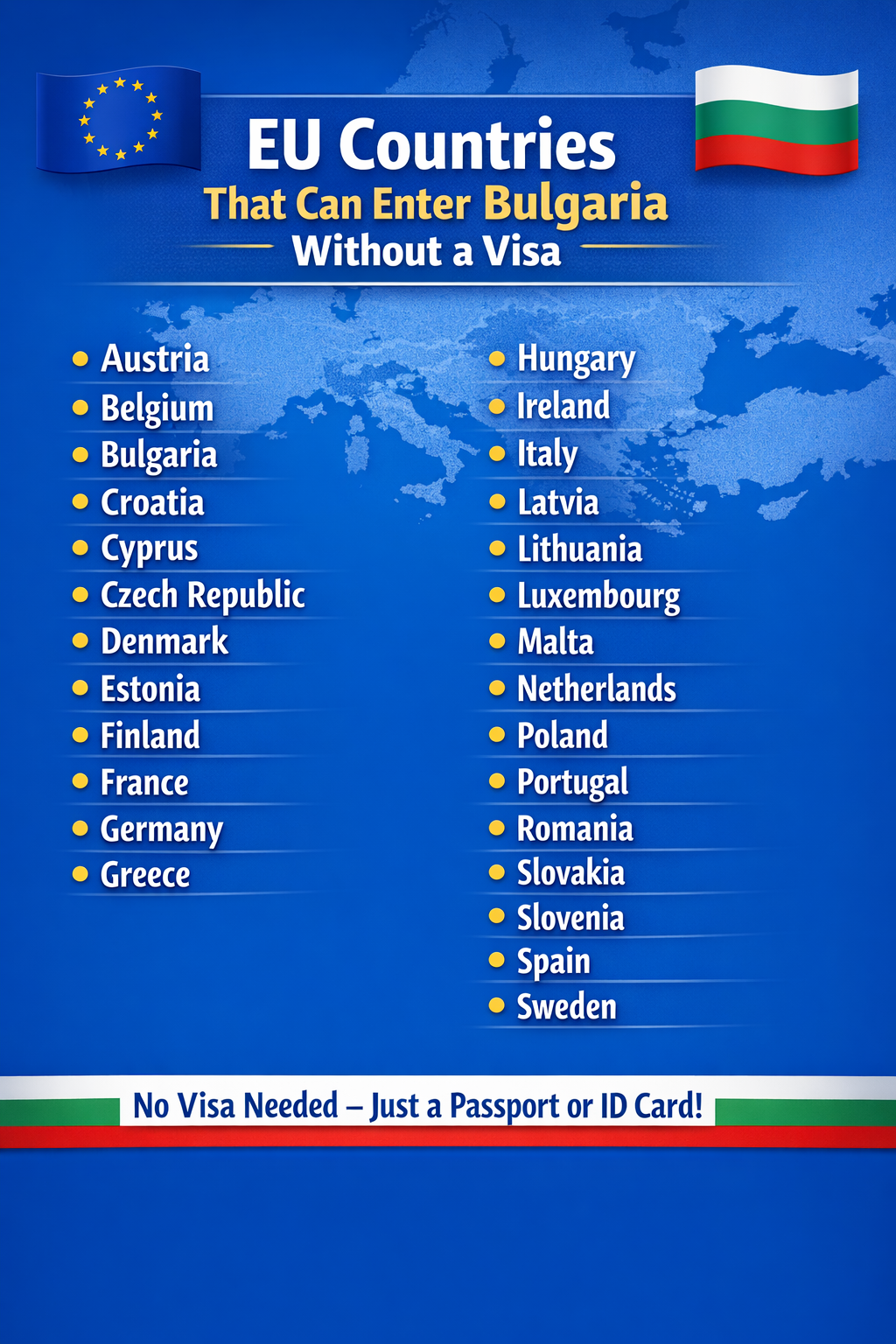
Which nationalities are visa-free?
This refers to the student who can enter Bulgaria without a visa. Once they are in Bulgaria they can apply for their residence permit.
When should the applicant apply for their visa?
When should the applicant apply for their visa?
Students who require a visa must apply well in advance and should begin checking visa requirements as early as possible. They should be strongly encouraged to book their visa appointment immediately after starting with MedConnect Europe, as appointment availability is often limited and slots may be scheduled several months in advance.
The Admissions Processing (AP) team will advise the Application Manager (AM) when the official visa letter can be expected, so that visa applications can be timed appropriately.
Documents Required and Explained
Documents Required and Explained
ACRO Certificate (Police Check)
ACRO Certificate (Police Check)
-
UK passport holders
-
Non-UK citizens legally living in the UK
As part of your visa process, you must show that your criminal history and good standing in the country that you reside in. The ACRO certificate is the UKs criminal record check service that provides all the required information for the purposes of living abroad. An ACRO certificate is different from a DBS check and for the visa you can only use an ACRO certificate.
Whilst our package includes the apostille services for documents of the university application, it does not include the legalization of the ACRO certificate for the visa application
Important Notice: ACRO certificates are only valid for 6 months from the date of issue in Bulgaria. You may have to apply for the ACRO certificate again for your Residency Card if your ACRO expires by the time you are able to apply for your Residency Card. THE ACRO CERTIFICATE WILL NEED TO BE APOSTILLED AND HAVE A TRANSLATION. If the translation is done in Bulgaria, then it MUST be NOTARISED. If the translation is done in the UK, it must be done by a translator authorised by the Bulgarian embassy in the UK. List of authorised translators – https://www.mfa.bg/en/embassies/uk/661. After the translation is complete, the student will also need to get the translation certified at the Bulgarian embassy during the visa appointment.
Students who require help with this service can reach out to Apostille Solutions who will assist them with both the apostille and the translation. Note: Apostille solutions do not get the translation certified since the student can do it themselves during the visa appointment.
Travel Insurance
Travel Insurance
-
UK passport holders
-
non-UK, non-EU passport holders
Travel insurance covers your medical expenses and various other expenses if in unfortunate circumstance if you require emergency medical care whilst you are abroad. A travel insurance policy can be bought in advance of your visa appointment as you will need to show proof of this as part of your visa application. The policy must cover a minimum of at least three months from your date of travel.
Please book your travel insurance after your appointment at the Bulgarian Embassy has been confirmed. You will need to enter a departure date for the travel insurance policy and this can be any date that falls after your appointment date.
Please Note for UK Students: The GHIC/EHIC card provided by the NHS is not accepted for the purposes of the visa. You must take out a travel insurance policy as the GHIC card does not cover all the requirements.
Visa Application Form
Visa Application Form
-
UK passport holders
-
non-UK, non-EU passport holders
The visa application form is straightforward and just requires you to fill in details about yourself and about your travel to Bulgaria. If you are unsure about any sections, you can ask our team or leave it blank and ask for help to complete the section when you visit the embassy for your appointment.
Valid Passport
Valid Passport
-
UK passport holders
-
non-UK, non-EU passport holders
To apply for your visa, you need to show that your passport is valid for at least 6 months from the date that you apply for your visa. If your passport is expiring sooner than the 6-month period, then you need to renew your passport as soon as possible. If you are thinking about renewing your passport within 2 weeks of travelling to Bulgaria, please contact us first. We will let you know if you should wait until after your enrolment is complete. If you are in a situation where you need to renew your passport, please always choose the Fast Track service. Do not risk using the normal service as it could take too long for your passport to arrive, and you may miss enrolment at your university.
Bank Statements
Bank Statements
-
UK passport holders
-
non-UK, non-EU passport holders
The bank statements that you provide for your visa application must cover at least three months prior to the visa appointment. There is no minimum amount requirement that you need to show however it is recommended having enough in the account to cover the tuition fees for a year. The bank statements can be of the applicant themselves or of the parents of the applicant.
If the parent will be sponsoring the applicant the entire duration of their studies, the applicant will need to provide a sponsorship declaration document. This document needs to be notarized.
If the applicant is unsure of the format, they can ask their Application Manager for an example document.
Ministry of Education Certificate
Ministry of Education Certificate
-
UK passport holders
-
non-UK, non-EU passport holders
As part of your visa application, you must prove that you have successfully applied at the university. For this, MedConnect Europe would have provided you with a total of two documents in Bulgarian language. One of these documents would be a certificate from the Ministry of Education.
The Ministry of Education letter will read: The person has been admitted as a student for the academic year 2025/2026 in the Master’s degree program (full-time study), field: Dentistry/Medicine, at Medical University –University Name
It is important to note that even though the letter says the person has been admitted, this does not act as an official admission notification. This letter is simply for the use of the visa application.
Official admission communications are shared with students on the specified ranking days.
University Accommodation Letter
University Accommodation Letter
-
UK passport holders
-
non-UK, non-EU passport holders
The other document would be a letter from the university as proof that you are eligible for university accommodation. This document also needs to be printed out as part of your visa application. Having this document is sufficient to prove your accommodation status. You do not need to provide any proof of address or the “notarial certified declaration from the owner” since you have this letter.
FOR PLOVDIV ONLY:
In previous visa letters issued prior to 2025, the statement:
“During his studies, (STUDENT NAME) will be housed in the Student Dormitories of the Medical University – Plovdiv, 2 Tsarevets Street.” was included in the accommodation letter from the University.
However, starting from 2025, the wording was changed to:
“At the request of the student, for the duration of the studies, the University can provide a dormitory, located at the address – Plovdiv, Str. “Tsarevets” No. 2.”
The second statement caused issues or rejected visa applications. Plovdiv Medical University has confirmed they will revert back to the original wording to avoid such issues.
In the case that the student only applies for their visa after they have already arrived in Bulgaria, they are able to use their tenant agreement and landlord declaration from their secured apartment in place of the accommodation letter. If the student chooses to use these two documents, both will need to be notarised.