
When choosing where to study medicine, most students look at tuition fees, entry requirements, or university rankings. But there’s one factor that could impact your success more than any of those: how you’ll be taught.
Modern medical education in Europe is changing — and one of the most effective innovations is Problem-Based Learning (PBL).
This method doesn’t just teach you the theory. It prepares you to apply it.
What Is Problem-Based Learning?
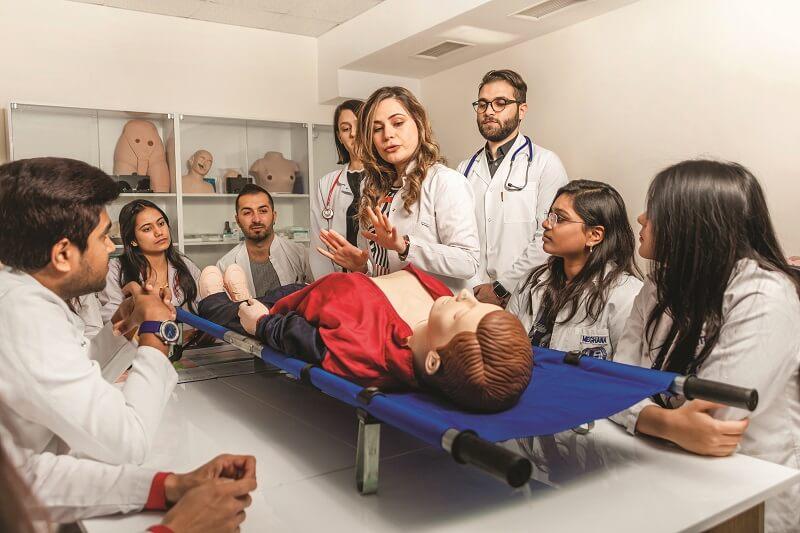
Problem-Based Learning (PBL) is a student-centred approach to education. Instead of passively memorising facts from lectures or textbooks, students are presented with a realistic medical problem — like a patient with a mysterious set of symptoms — and are challenged to figure it out.
You work in small groups, take ownership of your learning, and use critical thinking to identify what you need to know. Then, you research it, reconvene with your group, and propose a diagnosis or plan.
In short: you learn by doing — not by sitting through endless PowerPoint slides.
Why Was PBL Introduced in Medicine?
PBL was first introduced in medical schools in the 1960s, when educators realised that traditional lecture-heavy methods were falling short. Students could recall facts for exams, but struggled to apply them in real-life clinical scenarios.
By making the learning process more active, contextual, and collaborative, PBL helps medical students:
- Retain information longer
- Think like doctors from day one
- Communicate better with patients and peers
- Solve complex problems under pressure
What Does PBL Look Like in Practice?
Here’s how a typical PBL cycle works in a European medical university:
- You’re given a patient case.
Example: A young man arrives at A&E with chest pain and shortness of breath. - You discuss it with your group.
You clarify terms, brainstorm what you already know, and agree on what you need to research. - You study independently.
Everyone investigates their assigned topics — whether it’s ECG interpretation, risk factors, or lung anatomy. - You regroup and share findings.
Together, you work towards a diagnosis, treatment plan, or further investigation pathway. - You reflect.
The facilitator (usually a doctor or lecturer) guides the session but doesn’t give you the answers. Instead, they help you reflect on your reasoning and learning process.
By the end of this cycle, you’ve absorbed far more than just facts. You’ve built medical reasoning skills that will serve you for life.
Benefits of Problem-Based Learning
PBL isn’t just a “nicer” way to learn. It produces better doctors. Here’s how:
✅ Real-World Relevance
You’re not just cramming for exams — you’re preparing to solve real medical cases.
✅ Long-Term Knowledge Retention
By linking learning to context, you remember it better (and for longer).
✅ Better Teamwork & Communication
Medicine is a team sport. PBL teaches you how to communicate clearly and collaborate effectively.
✅ Faster Clinical Readiness
You’re comfortable with uncertainty, ambiguity, and patient interaction — long before your first hospital placement.
✅ Stronger Motivation
It’s easier to stay engaged when you’re solving real problems instead of memorising dry facts.
Is PBL Used at All Medical Universities?
Not all medical schools use PBL — and those that do vary in how much they integrate it. Some universities run fully PBL-based curricula, while others use a hybrid model, combining lectures with PBL sessions.
In Europe, universities in the Netherlands (like Maastricht University) are pioneers in PBL. But many universities across Bulgaria, Romania, Latvia, and Georgia are now integrating elements of PBL into their English-language medical courses.
When choosing a medical school, it’s worth asking:
- Do they use PBL as part of the curriculum?
- How are PBL sessions structured?
- Will you be assessed on your participation and performance?
Is PBL Better Than Traditional Teaching?
There’s no “one-size-fits-all” in education. Some students prefer structured lectures; others thrive in hands-on, interactive settings.
But in medicine, where your job involves real people with unpredictable problems, learning by doing often leads to better outcomes.
PBL helps you develop:
- Clinical reasoning
- Confidence in decision-making
- Adaptability under pressure
- Independence and initiative
It mimics the realities of being a doctor more closely than any textbook ever could.
Why This Matters When Studying Medicine Abroad
If you’re a UK student thinking about studying medicine in Europe, knowing how you’ll be taught is just as important as knowing where.
Medconnect Europe partners with top European medical universities that use PBL as part of their teaching. We’ll guide you toward options that don’t just get you qualified — they prepare you to become a confident, competent doctor.
Final Thoughts
Problem-Based Learning is more than a teaching method. It’s a philosophy of education that puts the student — and the patient — at the centre.
If you want to learn medicine in a way that prepares you for the real world, not just the exam hall, PBL is a powerful approach to consider.
Thinking of studying medicine abroad?
At Medconnect Europe, we help UK students find the right medical university — based on teaching style, support, location, and more. Book a free consultation to get tailored advice on where to study and how to apply.