
If you are preparing for a medical entrance exam in 2027, you can find plenty of Biology and Chemistry questions online. The harder part is finding practice that actually resembles the exam you are going to sit.
Table of Contents
That matters because European medical universities do not all use the same entrance exam. The subjects, question formats, time limits and admission requirements can vary between countries and universities, so checking the current requirements for your chosen programme should be the first step in your preparation. The European Commission’s guidance on university admission and entry conditions is a useful starting point when researching how admission works across Europe.
Once you know what your university expects, the next question is how to practise for it. General Biology and Chemistry resources can help you build your subject knowledge, but they do not necessarily give you enough experience with the type of questions, timing or exam conditions you will face.
That is where university-specific mock practice becomes useful. MedConnect Synapse gives students applying through MedConnect Europe full access to university-specific question banks and mock exams. If you want to test out the platform before enrolling, you can access a free demo to explore how it works.
What should you practise for a medical entrance exam?
Your preparation should begin with the requirements of the university you are applying to.
Before you start working through hundreds of questions, find out which subjects are tested, what topics are included, what type of questions you will face and how much time you will have. If the university publishes information about the examination format, use that as the basis for your preparation rather than relying on a generic medical entrance exam guide.
This is particularly important for students applying to European universities because there is no single entrance examination used across the continent. Some universities require written entrance exams, while others base admission on academic results or use a different assessment process altogether.
MedConnect’s university directory covers medical schools across countries including Bulgaria, Slovakia, Poland, Romania, Hungary, Latvia, Georgia and Italy, with different admission routes depending on the university and programme. You can explore the universities here.
Why generic question banks can leave gaps in your preparation
There is nothing wrong with using a general Biology or Chemistry question bank. It can be useful when you are learning a topic, revising material you have forgotten or checking whether you understand a particular concept.
The problem is relying on that type of practice all the way through your preparation.
A general question bank does not necessarily tell you whether you can handle the format of your university’s entrance exam. You could answer hundreds of Biology questions correctly and still struggle when you encounter an unfamiliar question style, a strict time limit or a full examination covering several topics.
That is why entrance exam preparation needs to move beyond simply asking, “Do I know Biology and Chemistry?”
You also need to ask, “Can I answer the questions I am likely to face quickly and accurately enough to perform well in the actual exam?”
Past papers are useful, but they are not always enough
Past papers are one of the first things students look for when they begin preparing for an entrance exam, and they can be extremely useful when official and up to date.
The difficulty is that universities do not always provide enough past papers for students to use throughout their preparation. You may find one paper from a previous admission cycle, but that does not give you enough opportunities to practise, identify weak areas and measure whether your performance is improving.
Mock exams solve a different problem.
Instead of relying on one previous paper, you can take a mock, review your answers, revise the areas where you struggled and then take another mock later in your preparation. Over time, this gives you a much clearer picture of how you are progressing.
For a student preparing for 2027 entry, that repeated practice can be particularly useful because it allows you to identify problems well before the actual examination.
What makes a useful medical entrance exam mock?
A good mock exam should resemble the examination you are preparing to take as closely as possible.
That means the questions should be relevant to the subjects and level you are preparing for, while the format and timing should give you a realistic experience of working under examination conditions.
It should also give you something useful after you finish. A score on its own does not tell you very much if you do not know which questions you got wrong or why your answer was incorrect.
This is why detailed explanations and performance tracking matter. They allow you to turn a poor result into a revision plan rather than simply moving on to the next set of questions.
How should you use mock exams during your preparation?
You do not have to wait until you have completed every topic before taking your first mock.
An early mock can give you a baseline. You may discover that your Biology knowledge is stronger than your Chemistry knowledge, or that you understand the content but take too long to answer certain types of questions. You might also find that a particular topic keeps appearing among your incorrect answers.
Those results give you something concrete to work on.
As your preparation develops, you can move from individual topic practice to mixed question sets and then to timed mock exams. Closer to the examination, your practice should look increasingly like the real thing, because knowing the material is only one part of being ready.
The process should be straightforward: take a mock, review the questions you missed, revise the areas that caused problems and then test yourself again.
Where can you get free medical entrance exam practice?
This is where MedConnect Synapse comes in.
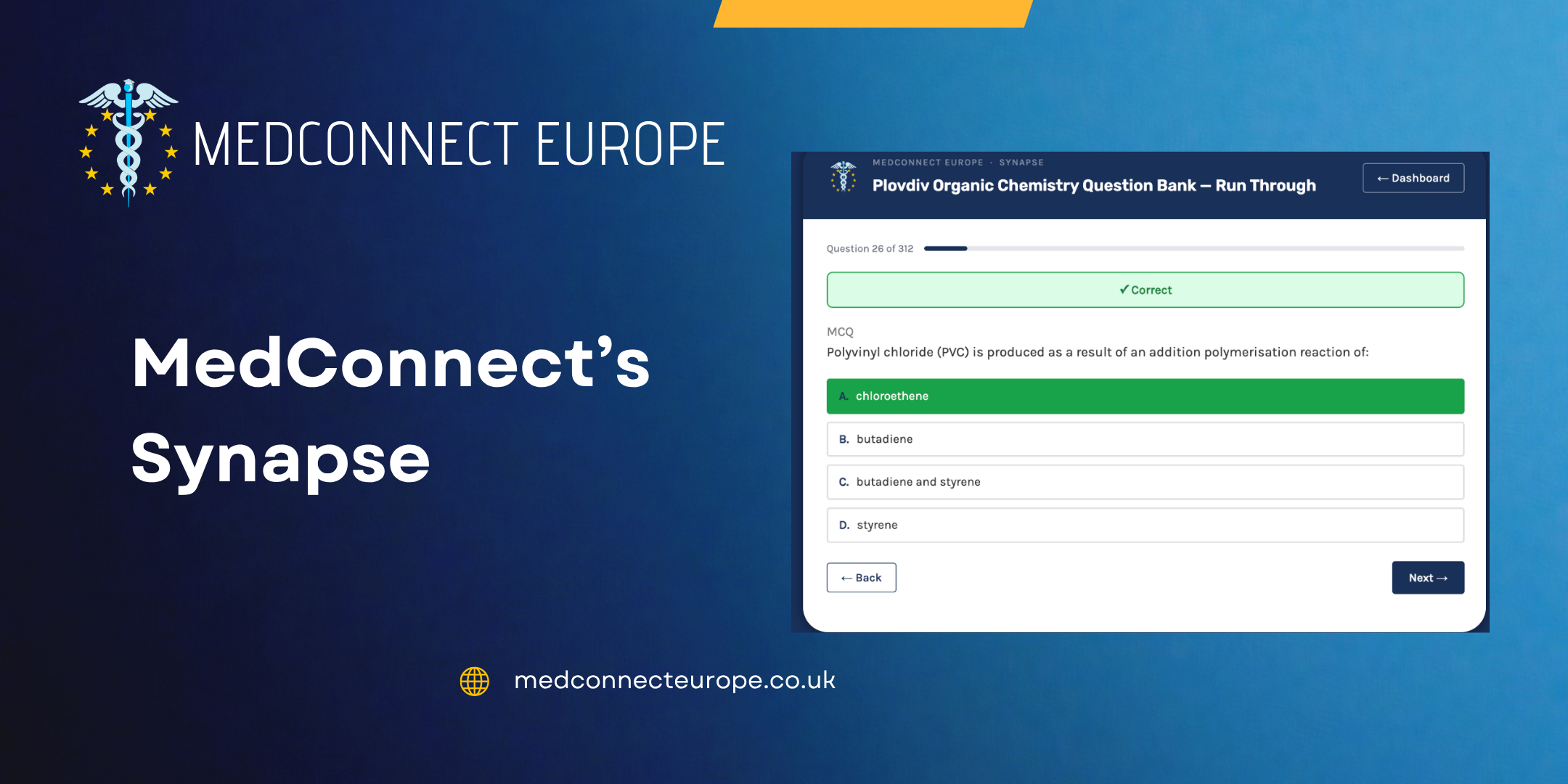
MedConnect Synapse is a free study platform designed specifically for students preparing for medical and dental entrance exams in Europe. It provides university-specific question banks, timed mock entrance exams, detailed answer explanations, adaptive learning and progress tracking. The platform currently has more than 2,000 practice questions and live question banks for Sofia, Plovdiv and Varna Medical Universities in Bulgaria and Pavol Jozef Šafárik University in Slovakia.
The important difference is the university-specific approach.
Instead of opening a generic Biology question bank and hoping that the questions are relevant, you can prepare around the university and examination you are actually targeting.
For students preparing for one of the universities currently covered by Synapse, that means you can practise the relevant question bank, take timed mocks and use your results to decide where to focus your revision next.
What can you do on Synapse?
Synapse brings the main parts of entrance exam practice into one place.
You can work through university-specific question banks rather than relying entirely on general science questions. The platform also includes timed mock entrance exams, allowing you to practise working within the time available instead of leaving that experience until the real examination.
When you finish a question, detailed answer explanations help you understand why an answer is correct. Synapse also uses adaptive learning to track your performance and direct more attention towards topics where you need additional practice. Your progress dashboard then gives you a way to see how your performance changes as you continue preparing.
That combination is important because mock practice should not end when you see your score. The useful part is knowing what the result tells you about your preparation and what you should do differently before your next mock.
Which universities are currently available on Synapse?
Synapse currently has university-specific question banks available for:
- Sofia Medical University
- Plovdiv Medical University
- Varna Medical University
- Pavol Jozef Šafárik University
The platform states that more universities are being added, so if your chosen university is not currently listed, check the platform for the latest coverage before planning your preparation around it.
This university-specific approach is particularly useful because not every MedConnect partner university requires a written entrance examination. For example, Andrzej Frycz Modrzewski University in Poland does not use a written entrance exam for its admission route, so a student applying there would need a different preparation strategy.
What if you get a low score on your first mock?
Do not treat your first mock as a final judgement on whether you can pass the entrance exam.
A first mock is most useful as a starting point. If you score lower than expected, look at what caused the result. You may have gaps in your subject knowledge, problems with timing or difficulty recognising certain question types.
Once you know what went wrong, you can change your preparation accordingly.
For example, if you are repeatedly losing marks in one area of Biology, spend more time revising that topic and then return to practice questions. If you are finishing the exam with several unanswered questions, focus on your pacing and take another timed mock once you have had time to work on it.
The point of repeated mock practice is not to keep collecting scores. It is to make each attempt more useful than the one before it.
When should you start taking medical entrance exam mocks?
There is no reason to leave your first mock until the week before the entrance exam.
Taking one earlier gives you information that you can use for the rest of your preparation. You may discover that you need to spend more time on Chemistry, that your Biology knowledge is stronger than you expected or that you need to work on your speed.
As you get closer to the exam, increase the amount of timed practice and full mock exams you complete. By the time you sit the real examination, working through a timed set of questions should not feel completely unfamiliar.
Start practising for free with Synapse
If you are preparing for a European medical or dental entrance exam in 2027, you can start practising without paying for another question bank.
Synapse is free to use and includes university-specific practice and mock exams designed around medical and dental entrance examinations in Europe. You can start with the available question banks, take mock exams, review your answers and track your progress as you prepare.
Start practising free with MedConnect Synapse
If your university is currently covered, you can choose it and start preparing around its entrance examination rather than relying entirely on generic Biology and Chemistry practice.
Frequently Asked Questions
Where can I practise for a medical entrance exam for free?
MedConnect Synapse provides free access to medical and dental entrance exam practice, including university-specific question banks and mock exams for the universities currently supported on the platform.
Is MedConnect Synapse actually free?
Yes. Synapse is available for free, so students can use the platform to practise for their medical or dental entrance exams without paying for access to the study platform.
Can I take a medical entrance exam mock online?
Yes. Synapse includes timed mock entrance exams designed to simulate the conditions of the medical and dental entrance exams it supports.
Should I use past papers or mock exams?
Both can be useful. Past papers can help you understand the examination, particularly when they are official and current, while mock exams give you more opportunities to practise and measure your progress throughout your preparation.
Are medical entrance exams the same at every European university?
No. Universities can use different subjects, question formats, timings and admission requirements. Your preparation should therefore be based on the specific university and programme you are applying to.
How many questions should I practise before a medical entrance exam?
There is no fixed number that guarantees you will be ready. The more useful measure is whether your practice is helping you improve your accuracy, timing and understanding of the topics you find difficult.
What should I do after taking a mock exam?
Review your incorrect answers and identify the topics or question types that caused the most difficulty. Use that information to guide your next revision sessions before taking another mock.
Prepare for the entrance exam you are actually taking
Medical entrance exam preparation is much more useful when it is connected to the university you are applying to.
Start by understanding the examination requirements, use general resources where you need them for subject revision, and then move into university-specific questions and timed mocks as your preparation develops.
If you are applying for 2027 entry and want somewhere to practise without paying for access, start practising for free with MedConnect Synapse.
- Free Medical Entrance Exam Practice for 2027: Mock Tests & Questions
- Study Medicine Without UCAT: Your Best 2027 Options
- Medical University Sofia: Entrance Exam, Requirements & How to Apply
- Medical School Interview Questions: What to Expect
- Medical Entrance Exam Preparation: 6 Powerful Synapse Features
Over 1,200 students placed at European medical universities — and counting. MedConnect Europe has guided UK & Irish students through applications, visas, and university life since 2015. See their stories →